

Key Points:
• Resisting arrest under N.J.S.A. 2C:29-2 occurs when a person purposely prevents or attempts to prevent a law enforcement officer from effecting an arrest.
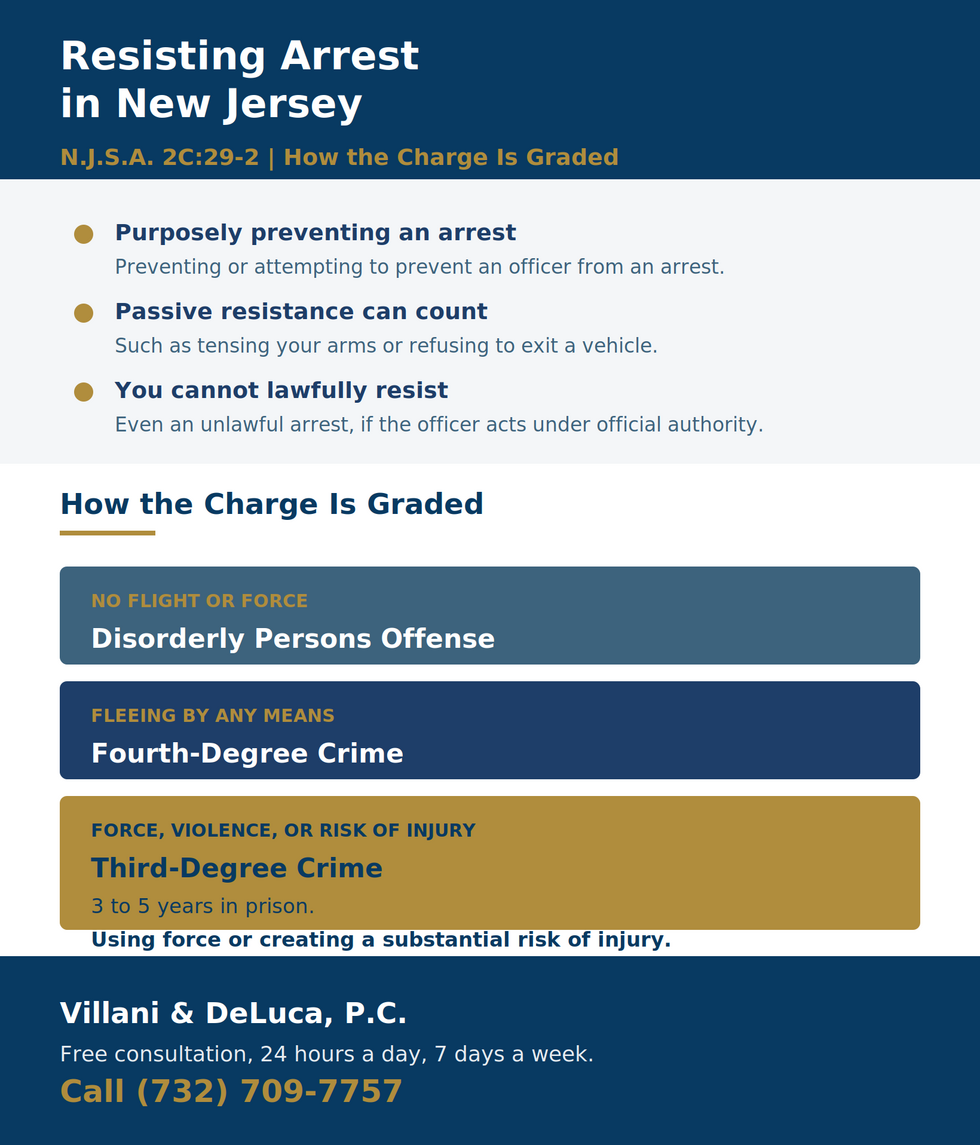
• Resisting arrest ranges from a disorderly persons offense to a third-degree crime (3 to 5 years in prison) depending on whether physical force, violence, or flight is involved.
• In New Jersey, you do not have the right to resist an arrest even if the arrest is unlawful as long as the officer is acting under color of official authority.
Resisting Arrest or Eluding Law Enforcement
New Jersey law enforcement agencies frequently charge individuals with resisting arrest when, in the judgment of police on the scene, situations get out of control. Police are trained to maintain control in any given situation in which they find themselves while on duty.
A common situation in Ocean County and Monmouth County, New Jersey, that often leads to individuals being charged by the police with resisting arrest involves disturbances outside of nightclubs. Police are often called upon to wade into an ongoing or developing fight in order to break the fight up. One thing that can happen in this situation is that an individual, either involved in a disturbance or simply observing a disturbance, is approached from behind by a police officer who attempts to arrest the individual, but who is not recognized as a police officer by the individual. The result often is that the individual is charged with resisting arrest, without that individual having had the intention to resist arrest. Similarly, it is easy to imagine situations in which a charge of resisting arrest or eluding law enforcement in New Jersey can arise from an innocent misunderstanding on the part of the party charged.
A Resisting Arrest or Eluding Law Enforcement Charge Can Carry Harsh Consequences
It may be easy to be inappropriately charged with resisting arrest in New Jersey or eluding law enforcement, but these are serious charges to be facing. The charges grow more serious when the act of resisting or eluding police creates a risk of death or injury to a third party. That is especially true where that risk is caused by the operation of a motor vehicle or a boat.
A criminal charge and a criminal record can carry serious consequences for your future. For example, if you are either employed or intend on becoming employed as a teacher or employee of a public school system in regular contact with pupils, a conviction for resisting arrest or eluding law enforcement will result in your inability to obtain or retain employment, as this charge is a “disqualifying” offense barring an individual from employment within a public school system under N.J.S.A. 18A:6-7.1. You owe it to your future to give yourself a chance at the best outcome possible for your case by retaining an experienced New Jersey criminal defense attorney.
Client Testimonial
"Carmine is the best. He is sharp and very accessible. Highly recommend for any legal matter. Furthermore, Carmine always delivers phenomenal results. He is the man for the job or legal issue. Don't waste your time with anyone else! 10 out of "10!"—Chris Dio
"I use Mr. Hoffman for all my family matters. He is great!!!! I recommend him and his firm highly!!!!" – Myriah Stanley
"Villani and his firm were extremely knowledgeable and professional handling my case. I'm extremely satisfied with the outcomes. God bless you and your firm for your dedicated work." – Bernard Perutti
Frequently Asked Questions
1. What actions can lead to a resisting arrest charge in New Jersey?
Under New Jersey law (N.J.S.A. 2C:29-2), a resisting arrest charge can be filed if a person purposely prevents or attempts to prevent a law enforcement officer from effecting an arrest. This isn't limited to physical fighting; it can include "passive resistance" like tensing your arms to prevent being handcuffed, refusing to get out of a vehicle, or running away. New Jersey courts have increasingly used body-camera footage to distinguish between a simple lack of cooperation and active resistance, making the preservation of digital evidence a top priority for your criminal defense attorney.
2. Is resisting arrest a felony or a misdemeanor?
People often ask, "is resisting arrest a felony?" In New Jersey, the answer depends on the severity of the incident. Resisting arrest is graded as follows:
-
Disorderly Persons Offense (Misdemeanor): Preventing an arrest without flight or force.
-
Fourth-Degree Crime (Felony): Fleeing from an officer by any means (such as running away on foot).
-
Third-Degree Crime (Felony): Using physical force or violence against the officer or creating a substantial risk of physical injury. While "misdemeanors" are handled in Municipal Court, felony-level indictable crimes are handled in Superior Court and carry significantly harsher penalties.
3. Can I be arrested for resisting arrest if the initial arrest was illegal?
Yes. This is a common point of confusion for those who have been arrested for resisting arrest. In New Jersey, you do not have the right to resist an arrest even if the officer lacks a valid warrant or probable cause, provided the officer is acting under "color of official authority." The law requires you to submit to the arrest and challenge its legality later in court. However, a lawyer can use the illegality of the initial stop as a strong mitigating factor to seek a dismissal or reduction of the charges.
4. What is "Eluding" and how does it differ from resisting arrest?
While resisting arrest usually involves a physical encounter or running away on foot, eluding specifically refers to a person operating a motor vehicle who fails to stop after being signaled by a police officer. Eluding is a very serious felony-level charge that often carries a "presumption of incarceration", especially if the flight created a risk of injury to the public or the police.
5. How can a lawyer help if I was arrested for resisting arrest?
A skilled attorney will review all available evidence, including police reports, witness statements, and body-worn camera footage. In many cases, what an officer describes as "resistance" was actually a natural physical reaction to pain or a medical condition. We also look for "procedural errors," such as whether the officer clearly identified themselves or if the level of force used by the officer was excessive, which may provide a defense for your actions.
Call An Experienced NJ Criminal Defense Attorney
If you have been charged with resisting arrest in New Jersey or eluding law enforcement in NJ, you need to discuss the facts of your case with an experienced New Jersey criminal defense attorney. Carmine R. Villani, Esq. is a partner in the law firm of Villani & DeLuca, P.C. located in Point Pleasant Beach, New Jersey. Mr. Villani is a criminal defense attorney who has been defending clients charged with criminal offenses in the Jersey Shore area for more than eighteen years. Mr. Villani is highly qualified, by skill and experience, to handle your resisting arrest/eluding case. Contact one of Villani & DeLuca's criminal defense attorneys at (732) 709-7757 for a free consultation about your resisting arrest/eluding charge. We represent clients throughout Ocean County and Monmouth County New Jersey.
Related Articles
Learn more about resisting arrest charges in New Jersey in our articles:
Trusted Resources
- New Jersey Courts, Municipal Courts - Directory, https://www.njcourts.gov/courts/municipal
- New Jersey Courts, Criminal Division - Superior Court, https://www.njcourts.gov/courts/superior/criminal
- New Jersey Division of Criminal Justice, Official Website, https://www.njoag.gov/about/divisions-and-offices/division-of-criminal-justice-home/
- Villani & DeLuca, P.C., NJ Criminal Statutes Resource Library, https://www.villanideluca.com/resources/new-jersey-statutes
- Villani & DeLuca, P.C., Resisting Arrest N.J.S.A. 2C:29-2 Breakdown, https://www.villanideluca.com/resources/new-jersey-statutes/nj-resisting-arrest-laws/resisting-arrest-nj-2c-29-2
- Villani & DeLuca, P.C., Legal Glossary, https://www.villanideluca.com/resources/legal-glossary